
Kruunusillat: engineering and car-free mobility
in ARCHITETTURA | architecture

© francesco pontalti I Kruunusillat.
Inaugurated in April 2026, the Crown Bridges (Kruunusillat) represent one of Helsinki’s most ambitious urban infrastructure projects. Born from an international competition won in 2013 by Knight Architects in collaboration with WSP Finland, the project created a system of three crossings connecting the city center to the island of Laajasalo. The development redefines the geography of metropolitan mobility and fosters the growth of a new coastal district built on land reclaimed from the sea. The construction process was not without hurdles: the project faced intense criticism, both for committing a massive investment to a bridge with “restricted” mobility (devoid of car traffic) and for significant cost overruns. The final budget exceeded €1 billion, compared to an original estimate of around €500 million.

© francesco pontalti I Kruunusillat.
Designed for a service life of approximately 200 years, the infrastructure embodies an architecture of great lightness and transparency. Its silhouette visually references the bay’s historic royal heritage, blending harmoniously into the maritime landscape. The construction phase demanded advanced engineering solutions to withstand the harsh Nordic climate, including complex continuous concrete pours for the central pylon. Knight Architects oversaw the project from concept to completion, refining the winning design to ensure technical feasibility, economic sustainability, and long-term durability.

© francesco pontalti I Kruunusillat.
The dramatic centerpiece of the development is the Kruunuvuorensilta: stretching 1.2 kilometers, it is now Finland’s longest and tallest bridge. The structure is dominated by a slender 135-meter-high diamond-shaped concrete pylon supporting two 250-meter cable-stayed spans. The infrastructure’s core strength — a rare feat for a project of this magnitude — is its total commitment to “active mobility”: access is strictly reserved for pedestrians, cyclists, and the light rail system, set to launch in early 2027. By driving a radical modal shift in daily commuting, the bridge stands as a key strategic pillar in Helsinki’s drive to achieve carbon neutrality by 2030.

© francesco pontalti I Kruunusillat.
Beyond its functional value, the social and urban impact was immediate: over the opening weekend alone, more than 50,000 people crossed it on foot and by bicycle, instantly transforming it into a vibrant public space and a new landmark for the capital. Far more than a mere connection, the Crown Bridges merge architecture and landscape into a single urban gesture, propelling the city toward a contemporary model of livability and sustainability. The only note of criticism concerns the architecture of the surrounding new urban district: a residential development widely judged as ordinary and homogeneous, not fully aligned with the boldness and formal elegance of the new infrastructure.
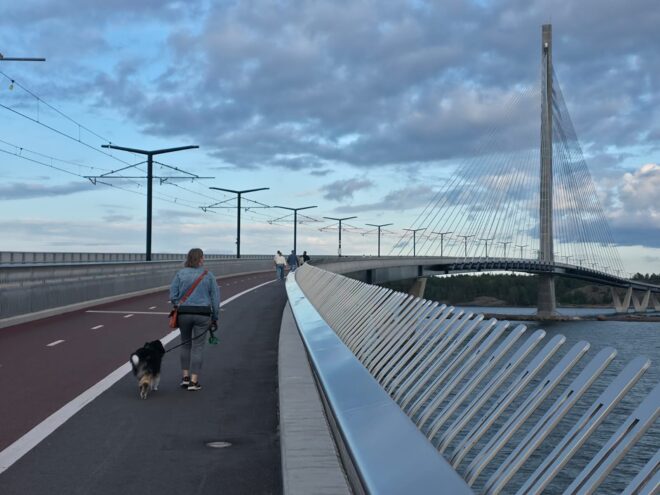
© francesco pontalti I Kruunusillat.